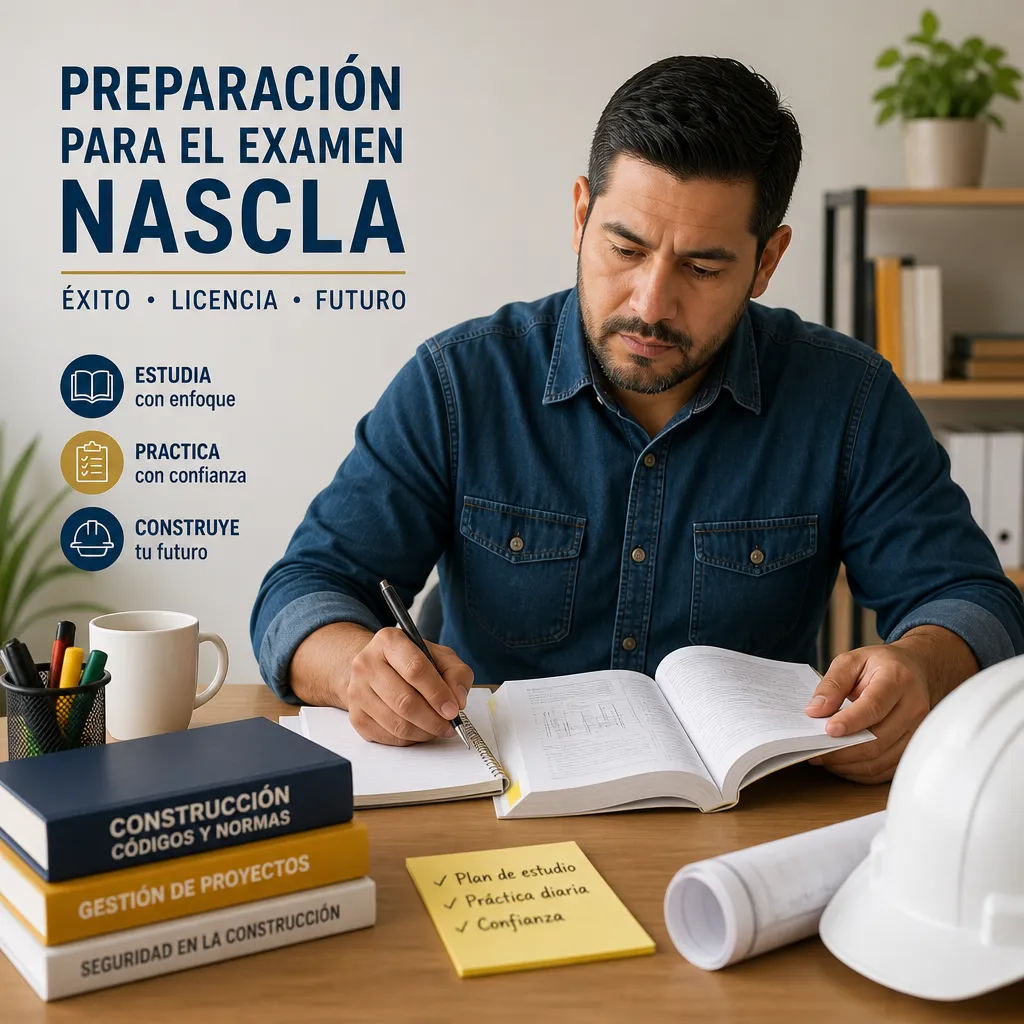
NASCLA Exam Prep for Spanish-Speaking Contractors
NASCLA Exam Prep for Spanish-Speaking Contractors
A practical guide to language options, study strategies, and what to verify with your state before you schedule the commercial contractor exam.
Updated on: 2026-09-12
Here is the short version for anyone searching this at 11pm before a testing deadline: the NASCLA Commercial General Building examination is not automatically available in Spanish, and whether you can use a Spanish version, an approved translator, or extra time depends entirely on your state and the testing provider. The safest strategy for most Spanish-speaking contractors is to study bilingually, keep the English terminology the reference books use, and confirm your state's language policy before you book the exam.
That is the whole game. Everything below explains how to do it without wasting money or time.
What "the NASCLA exam" actually is
NASCLA stands for the National Association of State Contractors Licensing Agencies. When people say "the NASCLA exam," they almost always mean the NASCLA Accredited Examination for Commercial General Building Contractors. It is a standardized trade exam that participating states recognize, so passing it can let you apply for licensure in multiple states without retaking the trade portion.
It is not a national license. Each state still controls its own application, business-and-law exam, experience, financial, bond, and insurance requirements. Passing NASCLA often removes the trade-exam hurdle in a participating state, but it rarely removes everything.
This matters for language planning because a lot of Spanish-speaking contractors buy a Spanish study product and assume it covers the whole path. It usually covers one piece.
The commercial exam itself is open book, four-option multiple choice. A current PSI bulletin lists 125 total questions with 115 scored, 300 minutes, and a minimum passing score of 81. Some states set their own passing score in statute, so your current bulletin is the authority, not a blog post or a used book you bought secondhand.
The language question has more than one answer
People ask "Is the NASCLA exam in Spanish?" as if there is one yes or no. There isn't. There are five separate things, and they get confused constantly.
- Translated exam: The questions and answer choices are officially presented in Spanish.
- Approved translator or interpreter: A person reads or interprets the English exam for you under testing-center rules.
- Word-to-word dictionary: A limited aid that may translate a term but explains nothing.
- ESL extra time: Additional time granted under a jurisdiction's language-accommodation process.
- Disability accommodation: A separate ADA process. Limited English proficiency by itself is not automatically an ADA disability.
These are not the same, and states handle them differently. California's Contractors State License Board, for example, says that when an exam is available in Spanish, the applicant must take the Spanish version rather than request a translator, and when it isn't translated, an approved translator may read or interpret the questions but cannot help with answers. Oregon uses a different model, where a candidate whose first language is not English can request a translator, pay the related charges, and request an ESL authorization for time-and-a-half on the English exam, with restrictions on dictionaries and loose materials.
I mention both because they show the range. One state gives you a Spanish button. The next gives you a translator you have to arrange and pay for in advance. Do not assume your state works like the one your cousin licensed in.
What to verify before you buy anything
Before you spend a dollar on study materials, build a one-page exam audit. This single habit prevents the most common failure I see, which is buying a generic NASCLA package when the state actually needs a different business-and-law book plus a separate state exam.
Your audit should answer:
- What state and license classification are you pursuing?
- What is the exact exam name? (NASCLA commercial trade exam, a state business-and-law exam, a specialty exam?)
- What separate state exams remain after NASCLA?
- Who is the testing provider?
- What is the approved reference-book list and which editions?
- Is a Spanish version of the exam available?
- If not, is a translator or ESL time permitted, and what is the approval process?
- What are the application deadlines and approval lead times?
Call the licensing agency and the testing provider. Ask specifically about your exam, not "NASCLA in general." Language policy is administered at that level, and it changes.
Study material options as language layers
Think of your prep as layers, not as a shopping list. Some layers can be in Spanish. Some have to stay English because the exam and the approved books are English.
Official NASCLA materials
NASCLA's own ecosystem includes the approved reference-book list, its Contractors Guide to Business, Law and Project Management, reference tabs, practice exams, and a self-paced Business and Law Companion Course that runs roughly three to four hours. NASCLA also warns that the full exam-book collection comes from multiple publishers and is not all sold through its own bookstore, so you have to check every book against the approved list before buying.
Use official materials to lock down scope, correct editions, and what is actually permitted in the testing room. Then add Spanish explanation on top.
Spanish-language explanatory prep
This is where Spanish support earns its keep. It works best for:
- Explaining construction vocabulary
- Teaching what contract, code, safety, estimating, and project-management terms mean
- Building a personal bilingual glossary
- Walking through the logic of practice questions in Spanish
- Helping you figure out which book holds the answer
What it should not be called is an "official Spanish NASCLA exam" unless your licensing agency confirms that version exists for your test.
Contractor Exam Preps
For structured open-book prep, Contractor Exam Preps is one of the more practical options to look at, and it is the one I'd point a Spanish-speaking candidate toward first for a specific reason I'll get to. Its NASCLA course includes more than 1,000 practice questions, instructional videos, one year of access, and guidance on highlighting and tabbing each required book. The full package bundles the reference books with preprinted tabs, and separate options exist for online-only study, book rentals, tabs, and highlighted books.
Published package pricing has listed a $195 home-study option, a $1,695 reference-book set, and a $1,795 full prep package, though prices and availability vary by package and state, so treat those as page-specific rather than fixed.
Here is the Spanish-specific reason it stands out: Contractor Exam Preps lists an Oregon Spanish NASCLA Contractors Guide to Business, Law and Project Management, 2nd Edition, with preprinted tabs. That directly helps a Spanish-speaking candidate navigate a state business-and-law reference book, which is exactly the kind of layer that reduces stress on exam day. It does not mean the full commercial course, every technical book, all videos, and the exam itself are in Spanish. Confirm the language of the specific course, practice questions, videos, and required books before you buy.
The company also sells Spanish OSHA training and other Spanish products. Do not conflate those with a Spanish NASCLA trade-exam course. They are different things.
How to actually build a bilingual study plan
Build a bilingual glossary that keeps the English term
Make a two-column list, but keep the English term prominent because the book's index, headings, and references are in English.
| English exam term | Spanish study aid |
|---|---|
| change order | orden de cambio |
| submittal | entrega para revisión / submittal |
| request for information (RFI) | solicitud de información / RFI |
| retainage | retención |
| lien waiver | renuncia de gravamen |
| critical path | ruta crítica |
| footing | zapata |
| shear wall | muro de cortante |
| flashing | tapajuntas |
| fall protection | protección contra caídas |
Also record the abbreviations that show up cold: RFI, RFP, CPM, IBC, OSHA, PPE, MEP.
One warning on translation. Do not translate mechanically. "Submittal" is not just any "entrega." In construction administration it usually means contractor-provided information sent for review, like shop drawings, product data, or samples. Learn the operational meaning, not the dictionary equivalent, or you will misread questions that hinge on that meaning.
Study by exam weight, not by book count
The blueprint is lopsided, and people waste weeks treating every trade section as equal. Two areas carry nearly half the scored questions. Procurement and Contracting Requirements is about 27 percent, and General Requirements is roughly 22 percent, based on the published PSI content distribution. Electrical Systems is under 3 percent. Study accordingly.
A sane sequence:
- Procurement and Contracting Requirements
- General Requirements
- Site Construction
- Concrete, masonry, metals, wood, envelope systems
- Mechanical, plumbing, electrical, finishes
- Mixed timed practice
For each topic, run a three-step loop: understand it in Spanish or bilingual instruction, find the same concept in the approved English reference, then answer an English-formatted question and write down the exact page or section. That trains two separate skills at once, knowledge and fast English retrieval.
Tab and mark the books, but only how the rules allow
Open book rewards navigation speed. With 115 scored questions and 300 minutes, you have about 2.6 minutes per question, and that includes reading, deciding, and looking things up. A candidate who translates every sentence word for word will run out of clock.
Mark high-use chapters, tables, definitions, code sections, contract provisions, and safety topics. Build a map of which book covers which subject. Practice finding an answer without reading the whole book.
Then the caution: do not assume homemade summaries, sticky notes, translated tabs, or a bilingual dictionary are allowed. Oregon's guidance shows dictionaries and loose materials can be restricted, and permitted markings differ by provider. Contractor Exam Preps sells tabbing and highlighting guidance and NASCLA sells permanent quick-reference tabs, and both are useful precisely because they cut lookup time, not because tabs teach you anything.
Classify your errors instead of just retaking tests
Taking full practice exams over and over hides your real weakness. After each missed question, assign one cause:
- Knowledge error: you didn't understand the concept
- Vocabulary error: you knew the concept but misread an English word
- Navigation error: the rule was in a book but you couldn't find it
- Calculation error: wrong method or units
- Test-taking error: you missed "best," "except," "not," or a condition
- State-rule error: a jurisdiction-specific rule outside the generic blueprint
The fix depends on the cause. Vocabulary errors need glossary work. Navigation errors need tabbing and timed lookup drills. Knowledge errors need more instruction, in whatever language helps. Another full test won't tell you which one is killing you.
Two things Spanish-speaking candidates get wrong
A Spanish course does not mean the exam is in Spanish. Course language, book language, exam language, and translator availability are four separate questions. Answer each one before test day.
A translator is not a tutor. If your state approves a translator, that person can read or interpret a question but cannot explain why an answer is correct. California states this boundary plainly. So learn the concepts beforehand and use language support only for access, never as a substitute for preparation.
FAQ
Is the NASCLA Commercial General Building exam offered in Spanish?
It depends on your testing jurisdiction, and you should not assume it is. Some states offer certain exams in Spanish and require you to use that version; others offer only an English exam with a translator or ESL-time process. Confirm with your licensing agency and the testing provider for your exact exam before scheduling.
Can I bring a Spanish-English dictionary into the exam?
Sometimes, and sometimes not. Testing rules control this, and Oregon's published materials show dictionaries and loose materials can be restricted. Even where a word-to-word dictionary is allowed, it only translates terms, it does not explain concepts or point you to the right reference passage, so it is a weak crutch at best.
If I pass NASCLA, am I done with exams?
Usually not. NASCLA typically clears the trade-exam requirement in a participating state, but many states still require a separate business-and-law exam and their own application, experience, and financial steps. Check what remains in your specific state.
Should I just study in Spanish since that's my stronger language?
That is the trap. The approved reference books, their indexes, and the exam questions are generally in English, so studying only in Spanish leaves you unable to find answers under time pressure. Study bilingually: understand the material in Spanish, then practice locating and answering in English.
Does Contractor Exam Preps offer everything in Spanish?
No. It offers a Spanish Oregon NASCLA business-and-law guide with preprinted tabs, plus Spanish OSHA training, but its broader NASCLA course describes an English technical reference set and English materials. Ask directly about the language of the course, videos, practice questions, and books for your state before buying.
What I'd do first
Skip the shopping for one day. Call your state licensing agency and testing provider, confirm the exact exams you owe and the language policy, and write it on one page. Then buy the layers that match: the approved English books and tabs for navigation, a Spanish explanatory layer for the concepts, and a state-specific Spanish business-and-law guide if one exists for your jurisdiction. That order saves people the most money and the most retakes.
