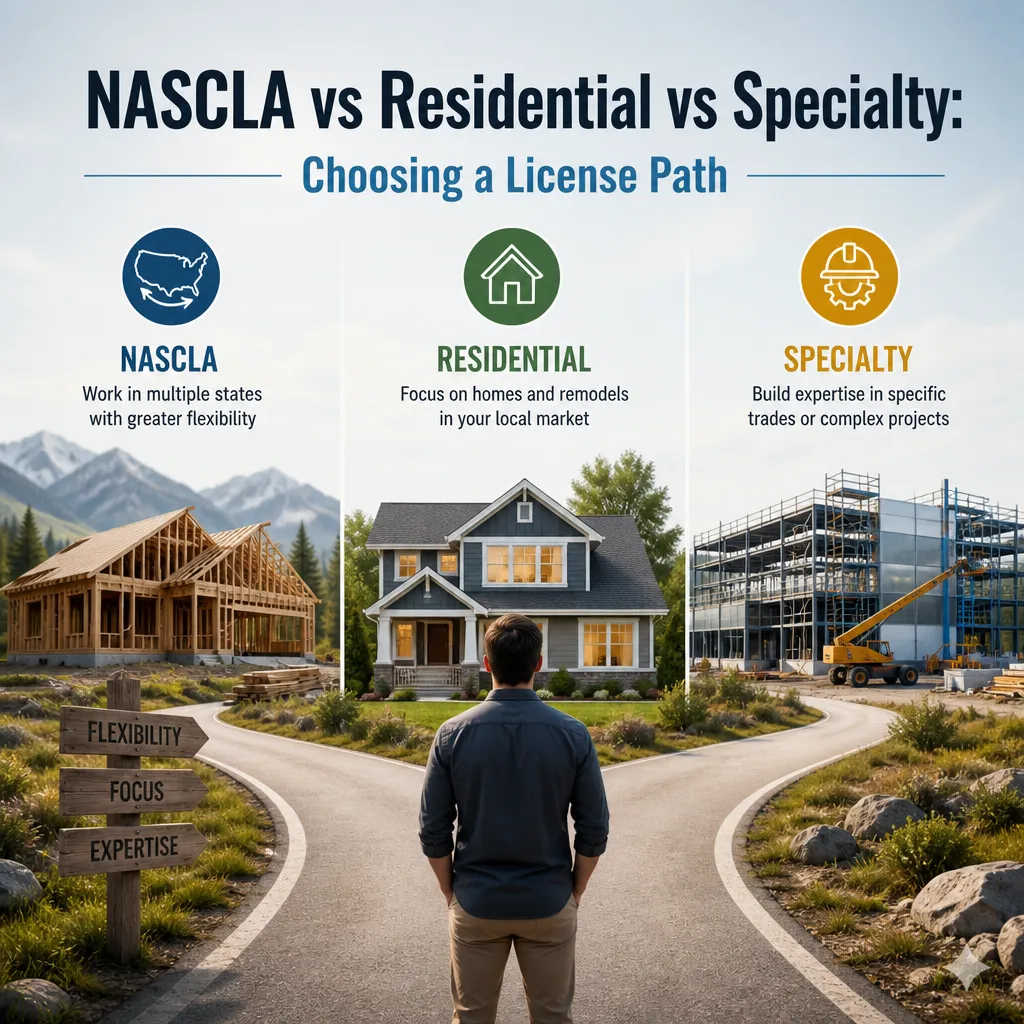
NASCLA vs Residential vs Specialty: Choosing a License Path
NASCLA vs Residential vs Specialty: Choosing a License Path
A practical guide to picking the right contractor license classification before you spend money on the wrong exam prep.
Updated on: 2026-09-13
The most expensive mistake I see contractors make isn't failing an exam. It's preparing for the wrong one. Someone hears "NASCLA gets you licensed in a bunch of states," buys a full book set, passes the exam, and then finds out their home state still wants a residential license and a separate business and law test for the work they actually do. Now they've spent money on the wrong path and still don't have a license.
Here's the short version before anything else. NASCLA, residential, and specialty are not three flavors of the same thing. NASCLA is a portable commercial general-building trade exam accepted by participating states. Residential and specialty are license classifications defined by each individual state. The state controls the final answer. Passing NASCLA does not issue a license by itself.
If you get that one distinction right, the rest of the decision becomes much simpler.
What each path actually is
Let me define these plainly, because the terminology trips people up constantly.
NASCLA stands for the National Association of State Contractors Licensing Agencies. When contractors say "the NASCLA exam," they almost always mean the NASCLA Accredited Examination for Commercial General Building Contractors. It's a standardized trade exam. Pass it once, and your result sits in a national database that you can send to participating state agencies instead of retaking each state's separate commercial trade test. It is not a national license and it does not waive a state's application, financial, or business-and-law requirements.
A residential contractor classification is a state-defined license that generally authorizes building, remodeling, repairing, or improving residential structures. The exact scope varies a lot. Some states draw the line by building type, occupancy, number of stories, or project value. Some call it "residential builder," "residential remodeler," or "home improvement contractor." North Carolina's Residential Contractor classification, for example, covers residential-code units plus ancillary work like driveways, sidewalks, and water and wastewater systems.
A specialty contractor path is limited to one trade, phase, or system: roofing, masonry, pools, insulation, painting, and so on. This is where the variation gets wild. Some states require a technical exam and a full license. Others only require registration. South Carolina's residential specialty registration requires no exam at all, is limited to three trade classifications, and asks for one year of residential experience per classification.
So already you can see the problem with lining these up as equals. One is an exam credential. Two are state classifications. Comparing them head to head only makes sense once you anchor to what work you'll contract for.
Start with the work, not the exam name
The first question is never "which exam is easiest." It's this:
What work will your business contract for directly?
That single answer eliminates most of the confusion. Here's the screen I'd run:
| Planned work | Most likely path |
|---|---|
| Build or remodel houses as the prime contractor | Residential contractor |
| Manage complete commercial building projects | Commercial/general-building license, often using NASCLA for the trade exam |
| Perform only one trade (roofing, concrete, pools, flooring, painting) | Specialty license or registration |
| Commercial general-building work across several NASCLA states | NASCLA plus each state's remaining requirements |
| Install electrical, plumbing, HVAC, or fire protection | Specialty or a separate trade-board credential |
One thing worth flagging: don't pick a residential license just because your projects are small. The issue is legal scope of work, not project price. Project-value limits are usually a separate license tier, which I'll get to.
Comparing the three at a glance
| Path | What it actually is | Best fit | Multi-state value | Main limitation |
|---|---|---|---|---|
| NASCLA commercial general building | Standardized commercial trade exam | Contractors doing commercial general-building work in multiple participating states | High where states accept the result | Doesn't issue a license or waive business-and-law and application requirements |
| Residential contractor | State-defined classification or license | Home builders, remodelers, residential general contractors | Usually low; recognition is state-specific | Often can't cover unrestricted commercial work |
| Specialty contractor | State-defined license, registration, or trade classification | Contractors focused on one trade or system | Usually low unless a specific reciprocity agreement exists | Can't contract outside the listed specialty |
The labels overlap in annoying ways. One state's "residential specialty contractor" registration is another state's full specialty license, and a third state hands the same trade to a separate electrical or mechanical board. Never assume the word means the same thing across state lines.
When NASCLA is worth it, and when it isn't
NASCLA earns its keep as your geographic footprint grows. The math is simple: one standardized trade exam instead of preparing for a separate commercial trade test in every state you want to work in.
The currently reported participating jurisdictions for the NASCLA Commercial General Building exam include Alabama, Arizona, Arkansas, California (with special conditions), Florida, Georgia, Louisiana, Mississippi, Nevada, New Mexico, North Carolina, Oregon, South Carolina, Tennessee, Utah, Virginia, West Virginia, and the U.S. Virgin Islands. Acceptance policies change, and acceptance is classification-specific, so confirm the current participating agencies before you pay for anything.
NASCLA makes sense when most of these are true:
- Your target work is commercial general building, not a single trade
- You realistically plan to license in multiple participating states
- The target states accept NASCLA for the exact classification you want
- You can handle each state's separate application, financial disclosure, insurance, bond, and qualifier requirements
- You understand state business-and-law exams still apply
NASCLA is overkill when:
- You'll only ever work in one state
- You perform one narrow trade
- Your state doesn't accept NASCLA for the classification you need
- You mainly build one- and two-family homes under a residential classification
The exam reduces repeated trade testing. It does nothing about the administrative cost of multi-state licensing. That part doesn't disappear.
The warning almost nobody hears first
"NASCLA accepted" does not mean "one exam gives you a license." This is the single most common misread, and it costs people real money.
Passing NASCLA typically handles the trade-exam portion. It doesn't touch the rest of the process. Arkansas still requires its own Business and Law exam. Florida requires Business & Finance, Contract Administration, and Project Management exams for its Division I contractors (General, Building, and Residential). Georgia, Louisiana, Mississippi, North Carolina, South Carolina, Tennessee, Utah, Virginia, and West Virginia all keep additional state requirements even when they accept the NASCLA result. NASCLA itself doesn't administer state business and law exams.
So before you treat NASCLA as a shortcut, list out what's left after the trade exam in your target states. Sometimes it's one more test. Sometimes it's three tests plus financial statements plus a bond. That total is your real workload.
Financial thresholds change the answer too
The "right path" isn't only NASCLA versus residential versus specialty. Within a classification, states often stack license tiers tied to money and project value. North Carolina is a clean example:
| NC limitation | Max single-project value | Financial qualification |
|---|---|---|
| Limited | $750,000 | $17,000+ in current assets over current liabilities, or $80,000 net worth; a $175,000 surety bond can substitute |
| Intermediate | $1,500,000 | $75,000+ working capital; a $500,000 surety bond can substitute |
| Unlimited | No project-value cap | $150,000+ working capital; a $1M surety bond can substitute |
All three still require an exam tied to the chosen classification. This is why "residential means small jobs" is wrong. Residential is a scope classification. The dollar ceiling is a separate tier decision layered on top.
Prime contractor or subcontractor?
One more filter that decides between specialty and everything else. A specialty path fits a trade subcontractor. It often falls short for a contractor who signs the whole construction contract with the owner.
Ask yourself:
- Will you contract for the complete project?
- Will you hire and coordinate unrelated subcontractors?
- Will you pull permits as the general contractor?
- Or will you only ever perform your own trade?
Minnesota, for instance, requires a residential building contractor or remodeler license when you contract directly with the owner of one-to-four-unit residential property to perform more than one special skill. Do only one skill and different rules may apply. The distinction between contracting with the owner and subcontracting matters more than most people expect.
Where Contractor Exam Preps fits
I'll be direct about what a prep provider is and isn't. Contractor Exam Preps is a state- and exam-specific preparation supplier. It is not a licensing board, it doesn't issue your license, and it can't confirm you qualify for a classification. The state agency does all of that. What a good prep provider does is get you ready for the exact exam and classification you've already confirmed you need.
That's where the format options matter, because the three paths call for different preparation:
- NASCLA: the Self Paced Home Study package at $195 covers online study materials with updates, automatic progress tracking, and unlimited practice exam attempts. The Best Value Full Prep Package at $1,795 adds the complete reference book set, permanent tabs, and the book buyback program. Given how document-heavy the open-book NASCLA exam is, pre-tabbed and highlighted books are the difference between finding an answer in 30 seconds and burning five minutes flipping pages. Used book discounts and the buyback program are worth checking, since used NASCLA textbooks can meaningfully cut the cost.
- Residential: state-specific residential courses and book packages, since residential exams are defined per state and don't transfer.
- Specialty: trade-specific prep for categories like roofing, pools, electrical, solar, and more, because a specialty exam is only useful when it matches your exact trade and testing vendor.
Among the ways to prepare, this is the pick I'd point most contractors toward: unlimited practice attempts with progress tracking, complete tabbed book sets, a price match guarantee on books, and buyback to recover cost. If you're weighing prep against a live seminar, the self-paced format wins for anyone with a working schedule, and the practice volume beats sitting in a room for a weekend. Just confirm current availability, book editions, and access periods at checkout, because some catalog listings run older prices or sell out.
One caution that applies to any provider: make sure the course targets your correct state, classification, testing vendor, and exam edition. A perfect NASCLA prep does nothing for a Florida roofing exam.
A quick verification checklist before you buy anything
Run this before choosing a path or paying for prep:
- State and locality where you'll work
- Exact project type: residential, commercial, industrial, institutional, or specialty
- Prime contractor or subcontractor
- Exact license classification and its permitted scope
- Whether NASCLA is accepted for that classification
- Which exams remain after NASCLA (especially business and law)
- Experience and qualifier rules
- Project-value or license-tier limits
- Working capital, net worth, bond, and insurance requirements
- Whether a separate trade board governs your work
- Current state and NASCLA fees
- Current book editions, allowed-reference rules, and course access period
FAQ
Does passing the NASCLA exam mean I'm licensed in every participating state?
No. It means your trade-exam result is on file and can be sent to participating agencies. You still apply to each state and meet its application, financial, insurance, bond, and business-and-law requirements. NASCLA reduces repeat trade testing; it doesn't hand you a license.
Is a residential license only for small projects?
Not really. Residential is a scope classification defined by building type, not by dollar amount. Some states then apply separate project-value tiers with their own financial requirements, like North Carolina's limited, intermediate, and unlimited levels. You can hold a residential classification and still handle large jobs if your tier allows it.
Do all specialty trades require an exam?
No, and this surprises people. South Carolina's residential specialty registration requires no exam and just one year of experience per trade classification, while certain mechanical specialty licenses in the same state do require testing. Always check whether your specific trade is licensed, registered, exempt, or handled by a separate board.
Should I get NASCLA if I only work in one state?
Usually not. If you'll stay in one state and your state has its own accepted process, NASCLA often adds cost and effort without a payoff. Its value shows up when you're pursuing the same commercial general-building classification across multiple participating states.
Can Contractor Exam Preps tell me which license I qualify for?
It can prepare you for the exam once you know your path, but eligibility is determined by your state licensing agency, not by any prep provider. Confirm your classification, experience, and financial requirements with the state first, then match the prep product to that exact exam.
The right choice comes down to scope, geography, whether you're the prime contractor, state acceptance, and your financial capacity. Figure out the state classification first. Then buy the exam prep that matches it, not the one that sounded impressive at a barbecue.
