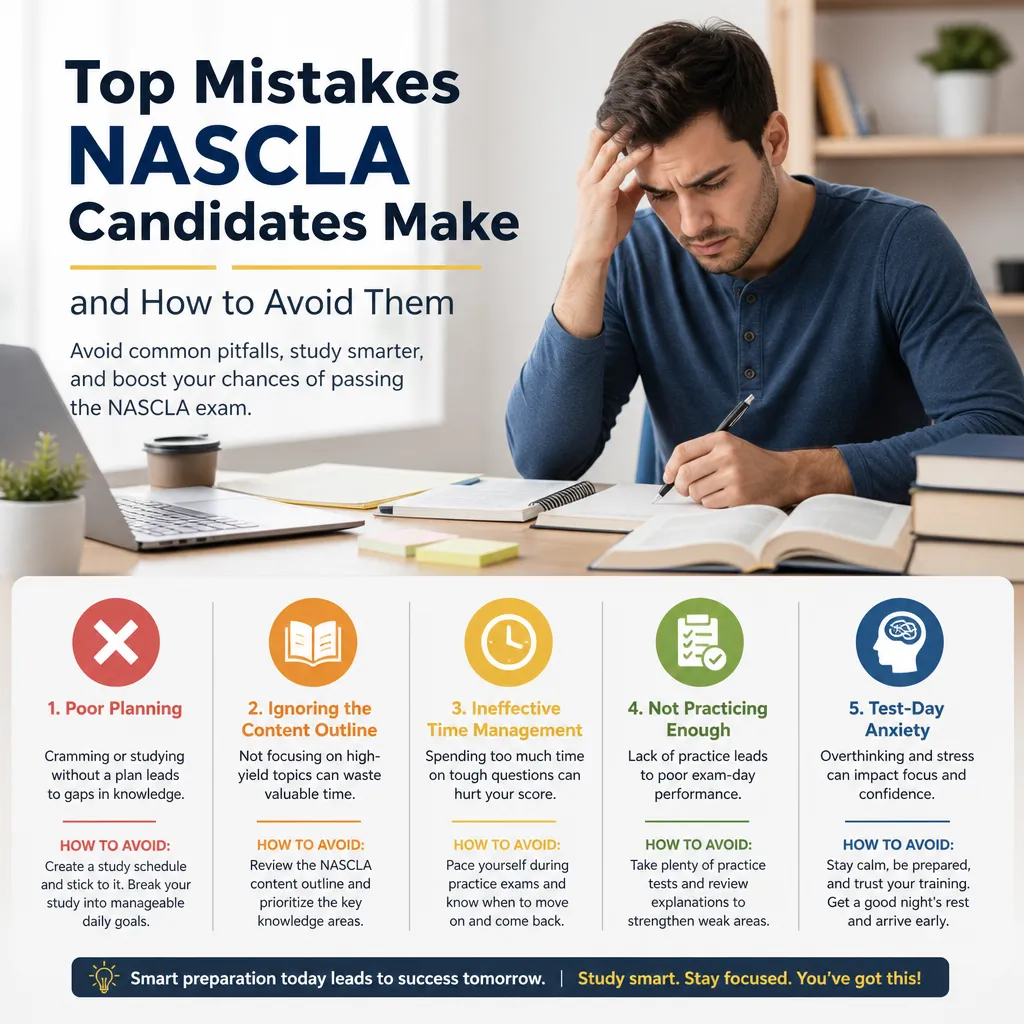
Top Mistakes NASCLA Candidates Make and How to Avoid Them
Top Mistakes NASCLA Candidates Make and How to Avoid Them
Open-book does not mean open-preparation. Here are the errors that cost prepared candidates their exam attempt, and how to sidestep each one.
Updated on: 2026-09-11
The single most common thing I hear from candidates who failed the NASCLA Accredited Examination for Commercial General Building Contractors is some version of "I didn't think I needed to study that hard, it's open-book." That sentence is the whole problem in one line. The exam gives you the books. It does not give you the time or the knowledge to find the answer if you have never opened them.
If you take nothing else from this: the NASCLA is open-book, not open-preparation. You still have to learn the material, and you have to build a fast, compliant reference system before you sit down. Everything below comes from watching where people slip, both in how they study and in what happens at the testing center.
Treating "open-book" as "easy"
The commercial exam displays 125 questions (115 scored, 10 unscored pretest questions you won't be able to identify) with 330 minutes on the clock, according to the 2026 NASCLA exam summary based on the July 7, 2026 PSI Candidate Information Bulletin. You need 81 correct out of 115 to pass. That works out to a little under three minutes per question if you use all your time.
Now imagine flipping through 24 approved references trying to remember which one covers scaffolding requirements. You burn four minutes on one question and you've eaten the budget for two others. Open-book testing rewards retrieval speed and judgment. Owning the books does almost nothing on its own.
The fix is boring and it works: study the content first, then rehearse finding answers. When you practice, don't just answer the question. Note which book, which chapter, and which table gave you the answer. That muscle memory is what saves you on exam day.
Studying from an outdated bulletin or the wrong editions
The PSI Candidate Information Bulletin controls everything that matters: question counts, the approved reference list, exact editions, fees, and testing-center rules. It changes. A bulletin from two years ago can send you into the exam with the wrong code edition or a book that won't be admitted.
Code questions in particular are tied to the specific edition listed in the bulletin. A newer or older code book may not match. The NASCLA handbook is explicit that code questions are based on the listed edition, and it points you back to the current bulletin for the approved list. Don't generalize the "later editions may be acceptable" language to code books. That leniency does not apply the same way there.
Before you buy books, before you tab anything, download the current bulletin from the official NASCLA site. Then check it again right before you schedule. Prep-provider product pages, including any package list, are the provider's description, not the final word on what's admissible on your exam date.
Getting the reference books wrong at the door
This is the mistake that stings the most, because it can happen to someone who studied hard.
Books get rejected at the testing center for marking and tabbing violations. The handbook permits highlighting, underlining, and permanent tabs or indexing. It prohibits handwritten notes, loose papers, attached extra material, and temporary tabs like Post-its. If your reference set breaks those rules, you can be left without your system, or worse.
A few things worth separating in your head:
- Allowed in the exam and useful for study are two different claims. A book can be great for learning and still not be on the approved list. Use the official list as the controlling source for what comes into the room.
- Permanent tabs only. Peel off the sticky notes before you leave home.
- No handwriting. No margin notes, no cheat sheets tucked in the pages.
If you buy a package with pre-installed tabs, confirm the tabs are permanent and that the titles and editions still match the current bulletin. This is exactly the kind of detail worth a five-minute check.
Tabbing and highlighting like it's a coloring book
Once your books are compliant, the next trap is organizing them badly.
Generic chapter tabs don't help much, because exam questions rarely announce which chapter they belong to. What helps is tabbing by searchable exam topic: procurement, lien requirements, fall protection, scaffolding, concrete, masonry, project administration. When a question mentions retainage or progress payments, you want a tab that says exactly that, not "Chapter 4."
Highlighting has the same failure mode. People highlight entire paragraphs, then can't find anything because the whole page glows yellow. Highlight the useful stuff: headings, definitions, exception language, formulas, table labels, and the specific rows or columns you're likely to pull from. Tables are where a lot of answers live, so make them easy to spot.
This retrieval-first approach is the core of how Contractor Exam Preps structures its NASCLA study method. The whole point of their tabbing and highlighting system is that you're learning where answers are located, not just reading about the subject. That's the right instinct. Just verify the specific book list and editions against your current bulletin, because the exam version you sit for is what governs.
Studying only the trades you already know
Here's where experienced contractors trip. They know the field. So they spend their study time on construction methods and skim the paperwork side. The exam is weighted the opposite way.
| Subject area | Scored questions |
|---|---|
| Procurement and Contracting Requirements | 31 |
| General Requirements | 25 |
| Site Construction | 15 |
| Concrete | 6 |
| Metals | 6 |
| Mechanical and Plumbing Systems | 6 |
| Wood | 5 |
| Thermal and Moisture Protection | 5 |
| Finishes | 5 |
| Doors, Windows, and Glazing | 4 |
| Masonry | 4 |
| Electrical Systems | 3 |
Procurement, Contracting Requirements, and General Requirements together are 56 of 115 scored questions. That's roughly 49% of your score sitting in two domains that have nothing to do with pouring concrete or framing a wall. If you're strong in the field and weak on contracts and project administration, that's where your study hours should go, not the other way around.
Field experience is a foundation, not a substitute. NASCLA builds its questions from a national job analysis and a formal development process, which means the exact terminology, exceptions, and answer wording won't always match how things sound on a job site.
Practicing questions without reviewing them
Grinding through a thousand practice questions and glancing at the score does very little. You can start recognizing familiar questions without ever learning the underlying rule or where it lives in the books.
For every question you miss, write down the reason:
- Knowledge gap (didn't know it)
- Misread the wording
- Wrong book (looked in the wrong reference)
- Too slow (couldn't find it in time)
- Calculation error
- Careless selection
Then go find and mark the correct, compliant reference location. That last step is what converts a wrong answer into a faster lookup next time. Unlimited practice attempts only help if you're using them to close specific gaps, not to feel busy.
Never simulating the real thing
Short quizzes hide two things: fatigue and pacing. You won't feel the drag of a 330-minute session until you sit through one. And you won't know if your navigation is slow until you're doing it under a clock.
Run at least one or two full, timed, mixed-topic sessions using the exact printed reference system you plan to bring. Include calculations, and practice reading the onsite diagram or blueprint packet that the exam provides in addition to the approved references. If you've only prepared by reading prose, a plan-reading question can rattle you.
Two practical habits for the room, both preparation advice rather than NASCLA rules:
- Set a rough pace and flag hard questions when the interface allows it. Don't let one brutal lookup eat the time for five easier questions.
- Learn synonyms and each book's internal structure. Index terms vary by edition and may not match the question's wording, so know how to reach an answer through headings, tables, and related terms.
Logistics failures that end the day before it starts
A prepared candidate can still lose the attempt to something completely avoidable.
- Identification. You need valid, government-issued photo ID with your signature. Inspect it well before exam day. If there's a problem, the handbook says to contact PSI at least three weeks out.
- Arrival and cancellation. Arriving after the start time, not showing, or cancelling too late can forfeit your fee and the attempt. Confirm the location, arrival window, and cancellation deadline from the current PSI instructions, not from memory of some other contractor exam.
- Calculator. Only a silent, non-printing, non-programmable calculator is permitted. No phones, no programmable devices. Verify before you go.
- Eligibility window. You get one year from application approval and up to three attempts in that window. Don't sit on your approval.
None of this is glamorous. All of it can undo months of studying.
Confusing three different outcomes
This is where a lot of confusion lives, so keep these separate:
- Passing the NASCLA exam. You cleared the accredited examination.
- Transmitting a transcript. Passing doesn't automatically notify state agencies. You link your score in NED and buy a transcript for each state agency. Per NASCLA, transcripts run $45 each and are valid for two years.
- Getting a state license. The exam may substitute for a state's trade examination in participating jurisdictions, but the state can still require business and law, financial, experience, insurance, or entity qualifications. Tennessee, for example, separately requires a Business and Law exam and describes NASCLA as reducing redundant requirements, not replacing its whole process. Tennessee also moved exam administration to a new provider in 2026, which is a reminder to always confirm the provider and bulletin for your specific exam.
Two smaller account mistakes after passing: don't create multiple NED accounts (duplicates delay score linkage, which can take up to 72 hours after upload), and don't forget the transcript step for every state you're targeting.
And the one with real consequences: don't try to circumvent security rules. Cheating can invalidate your score, forfeit your fee, trigger a 12-month reapplication bar, and open the door to legal action. That's a different order of problem than a failed attempt.
What I would do first
If you're starting this week, here's the order that works:
- Download the current PSI bulletin. Confirm question counts, the reference list, exact editions, and fees.
- Build or buy a compliant book set. Match every title and edition to the bulletin. Permanent tabs only, no handwriting.
- Take a diagnostic pass on all 12 subject areas. Find your weak domains, expecting them to be on the contracts and general-requirements side.
- Study to the weighting, not to your comfort zone. The two biggest domains deserve the most hours.
- Practice with review discipline. Log the reason for every miss and mark the reference location.
- Simulate the full timed exam at least once with your real books.
- Sort logistics early. ID, calculator, appointment, cancellation deadline.
Contractor Exam Preps builds its self-paced study packages around most of this: reference books, permanent tabs, progress tracking, instructional videos, and over 1,000 practice questions with unlimited attempts, plus a book buyback program and price match. It's a solid way to compress the setup work. Just treat the current official bulletin as the final authority on what's admissible the day you test.
FAQ
Is the NASCLA exam really open-book?
Yes, it's computer-based and open-book, but that's easy to misread. You bring the approved references, yet you still need to know the material well enough to find answers fast within a 330-minute limit. Candidates who lean on "open-book" and skip real study are the ones who run out of time.
How many questions do I need to get right to pass?
You need 81 correct out of 115 scored questions. The exam displays 125 total, with 10 unscored pretest questions mixed in that you can't identify. Check the current PSI bulletin before scheduling, since counts and standards can change.
Does passing NASCLA give me a contractor license?
No. Passing may satisfy a state's trade-examination requirement in participating jurisdictions, but each state agency sets its own licensing requirements, which can include business and law, financial, experience, or insurance conditions. You also purchase a separate transcript for each state agency after you pass.
Can I bring any relevant book into the exam?
Only books on the approved reference list are admitted, and only with permitted markings. A book can be genuinely useful for studying and still be inadmissible in the testing center. Use the current bulletin's list as the controlling source, and keep tabs permanent with no handwritten notes.
How should I tab my reference books?
Tab by searchable exam topic rather than by chapter, so a question about, say, lien requirements or fall protection maps to a tab that says exactly that. Keep tabs permanent, highlight targeted content like tables and definitions instead of whole paragraphs, and practice finding answers using that system before exam day.
