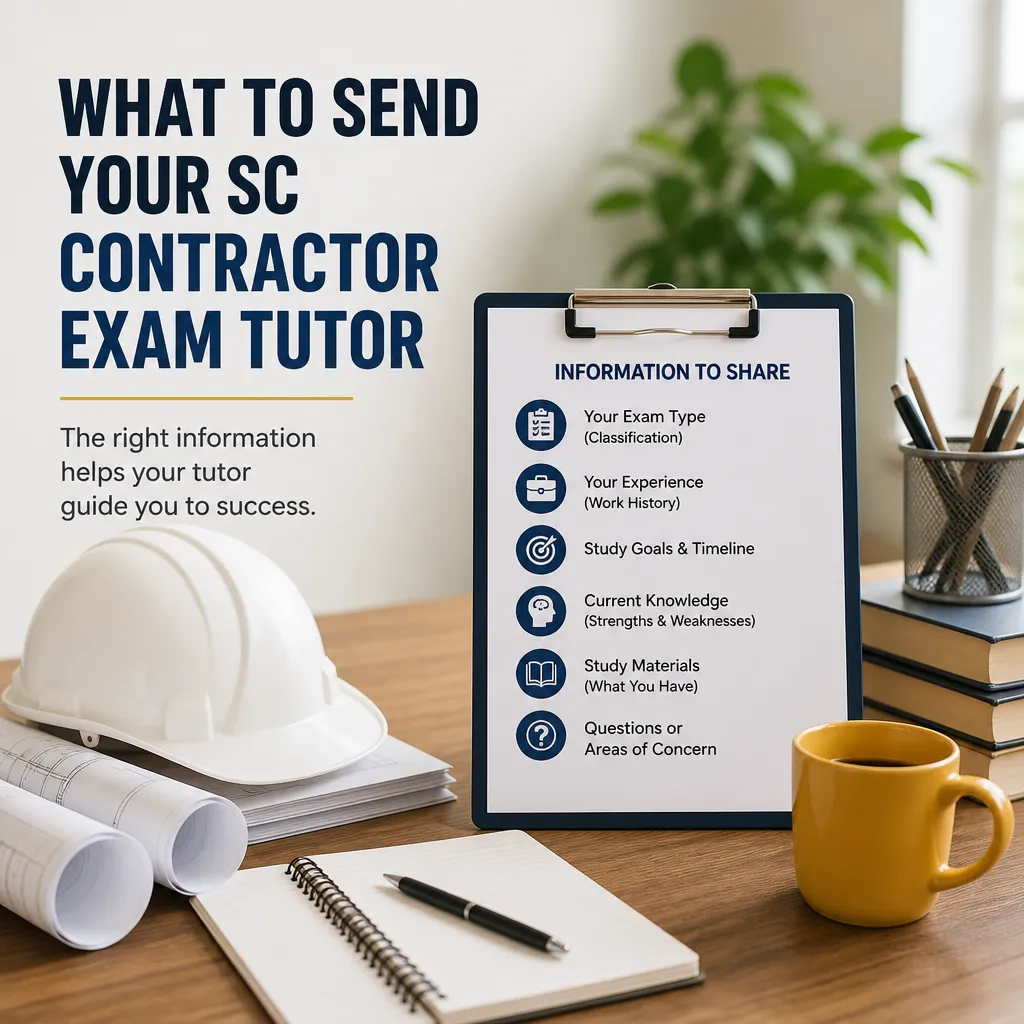
What to Send Your SC Contractor Exam Tutor First
What to Send Your SC Contractor Exam Tutor First
A pre-session checklist of the exact details, documents, and practice results your tutor needs before your first South Carolina contractor exam coaching call.
Updated on: 2026-10-09
The fastest way to waste a tutoring session is to show up with "I need help passing the contractor exam" and nothing else. I have watched it happen. The first fifteen minutes get spent figuring out which exam you are even sitting, which edition of a reference you own, and whether you have taken a practice test yet. That is time you paid for, gone to intake questions you could have answered in an email the night before.
So here is the practical version: what to gather and send to your tutor before session one, and roughly what happens after you ask for individual help. If you are still deciding whether one-on-one coaching is worth the money at all, that is a separate question worth reading about on its own. This piece assumes you have decided and now want the first session to actually move the needle.
Start with the exact exam and classification
The single most useful thing you can send is the precise exam you are registered for, not the general category.
South Carolina's contractor licensing splits several ways. There is the business and law portion that most candidates take. Then there are trade exams tied to your classification, whether that is building, mechanical, electrical, plumbing, or something narrower. Some candidates are pursuing the NASCLA accredited exam because it carries across multiple states. A tutor coaching you for the SC business and law exam is working from different material than one prepping you for a NASCLA trade exam.
Send:
- The exam name exactly as it appears on your registration or the candidate bulletin
- Your intended license classification and limit (general, mechanical, specialty, and so on)
- Whether you are taking business/law, a trade exam, or both
- Your test provider and testing location if you already know it
If you are not sure which classification fits the work you plan to do, say that plainly. It changes what the tutor focuses on, and it is better addressed before you book than discovered mid-session. There is a solid breakdown of how the classifications differ in the guide on choosing the right South Carolina contractor license if you want to sort it out first.
The candidate bulletin is not optional
Every SC contractor exam has a candidate information bulletin published by the testing provider. It lists the number of questions, the time limit, the passing score, whether the exam is open book, and the exact reference list.
Send the bulletin, or at least the version and date of it. Bulletins get revised. A tutor who preps you against last year's reference list when the exam adopted a new code edition is setting you up to study the wrong material. This is the most common quiet failure I see, and it is entirely avoidable.
If you cannot find the current bulletin, tell your tutor that too. Finding it is a reasonable first task, but you want that confirmed, not assumed.
List your reference editions, down to the year
SC contractor exams are usually open book. That means the editions of your references matter more than almost anything else.
A 2021 code book and a 2024 code book will have pages in different places, tables that moved, and sometimes answers that changed. If you walk into the exam with the wrong edition, your tabs point to nothing and your practice time was spent memorizing locations that no longer exist.
Send your tutor a list like this:
- Each required reference title
- The edition or publication year of the copy you own
- Whether your copy is tabbed and highlighted or still clean
- Anything you are missing and still need to buy or rent
This last point matters for timing. If you are short a reference, you want to know on day one whether to buy or rent it. 1 Exam Prep offers both exam book purchase and rental options with tabs and highlights already in place, which is worth flagging if you do not want to spend a weekend tabbing a code book yourself. A good tutor will tell you which references are worth owning versus renting based on how often you will reference them again after the exam.
Send your practice test results, not just "I studied"
If you have taken any practice exams, send the scores. Not a summary. The actual numbers, broken down by section if you have them.
"I got about 60 percent" is useful. "I got 72 percent on business law, 48 percent on the mechanical trade section, and I ran out of time with eight questions left" is far more useful. The second version tells a tutor exactly where to spend your money.
Include:
- Your most recent practice test score, overall and by topic area
- Whether you finished in the allotted time
- Which practice bank or course the questions came from
- How many full practice exams you have taken, if any
If you have not taken a single practice test, say so. That is not a problem, but it means your tutor's first job is to get a baseline before anything else. Do not inflate where you are. Coaching built on an overestimate of your readiness is worse than coaching that starts from zero.
1 Exam Prep's online courses come with thousands of practice questions, so if you are a student there, your tutor can likely pull your activity directly. Even then, flagging the areas you already know feel shaky saves everyone time.
Name the question types that keep tripping you
This is the part most candidates skip, and it is often the most valuable thing you can hand over.
Think back through your practice sessions. Which questions do you consistently miss or guess on? Patterns tend to fall into a few buckets:
- Code lookup questions where you know the answer exists but cannot find the page fast enough
- Calculation questions involving load, estimating, or area math
- Business and law scenarios about liens, contracts, workers' comp, or licensing rules
- "Which of the following is NOT" phrasing that trips you on reading comprehension more than knowledge
- Timing, where you know the material but cannot work fast enough to finish
Write down two or three that genuinely frustrate you, with a specific example if you can remember one. A tutor can teach lookup speed very differently than they teach estimating math. Telling them the category up front means session one is problem solving, not diagnosis.
A quick pre-session checklist
Here is the whole thing in one place. Send these before your first session:
| Item | What to include |
|---|---|
| Exact exam | Exam name, classification, business/law vs trade, test provider |
| Candidate bulletin | Current version and date, or a note that you need it confirmed |
| Reference editions | Each title with its year, tabbed or not, anything missing |
| Practice results | Most recent scores by section, timing, number of attempts |
| Troublesome areas | Two or three question types that consistently cost you points |
| Target date | When you want to sit the exam, and any hard deadline |
| Constraints | Study hours per week, work schedule, anything that limits prep time |
If you can only manage half this list before session one, prioritize the exam name, the reference editions, and your practice results. Those three carry the most weight.
What happens when you request individual tutoring
I want to be careful here, because intake processes change and I will not describe a booking flow as if it were fixed fact. Confirm the current steps directly with the provider before you rely on them.
Based on how 1 Exam Prep structures its one-to-one tutoring, the general pattern looks like this. You reach out through the website or by phone, text, or email. Reviews from students mention an orientation or intake conversation early on, where an advisor walks through the process and your next steps. Candidates named Chris and Carlos come up repeatedly in that role, with students noting they explained the whole process and helped identify which courses or materials fit their situation.
From there, tutoring is scheduled per session with custom pricing rather than a fixed package, so the exact cadence depends on what your baseline and target date call for. If you send the checklist above before that first scheduled session, the advisor can skip the diagnosis and get straight into strategy.
What I would verify before booking: the current request method, which specific SC exams the tutoring supports, and how sessions are priced and scheduled. Ask those three questions in your first message and you will have no surprises.
What I would do first
If I were booking tutoring tomorrow, I would do three things before sending a single message.
First, I would download the current candidate bulletin and confirm the reference editions it names against the books I actually own. That one check catches the most expensive mistake.
Second, I would take one full timed practice test, even if I bombed it, so my tutor has a real baseline instead of a guess. A bad score I can see beats a good feeling I cannot measure.
Third, I would write down the two question types that scare me most. Naming them makes the first session sharper, and it forces me to be specific about where I actually stand.
Then I would send the checklist, ask my three verification questions, and book.
FAQ
What if I do not know which exam classification I need yet?
Send that uncertainty to your tutor directly. It is a legitimate first topic, and sorting it out early prevents you from studying material for the wrong license. An advisor can match your intended work to a classification, but you want that settled before you buy references, since the reference list depends on it.
Do I really need to share my practice scores if they are bad?
Yes, especially if they are bad. A low score is diagnostic gold. It tells your tutor exactly which sections need the hours. Hiding a weak score or rounding it up just means you pay for session time spent rediscovering what you already knew.
Is the candidate bulletin the same thing as the study materials?
No. The bulletin is the testing provider's rulebook for the exam itself: question count, time limit, passing score, and the approved reference list. Study materials are the courses and practice questions you use to prepare. The bulletin tells you what to study against; the materials are how you study. You need both, and the bulletin comes first.
How far ahead of my exam date should I book tutoring?
It depends entirely on your baseline, which is why the practice score matters so much. Someone scoring in the low 50s needs more lead time than someone already near passing. Rather than picking an arbitrary number of weeks, send your score and target date and let the tutor tell you whether the timeline is realistic. If it is not, better to hear that now than two days before the test.
